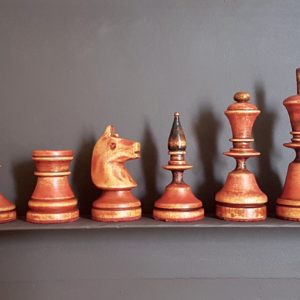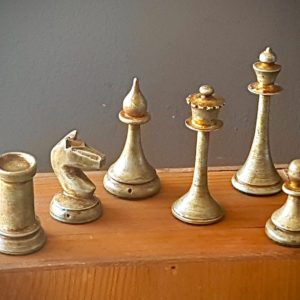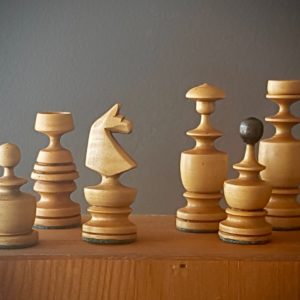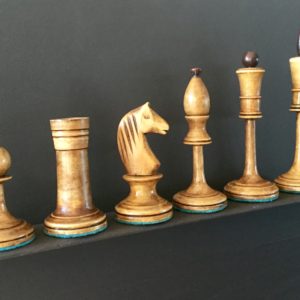


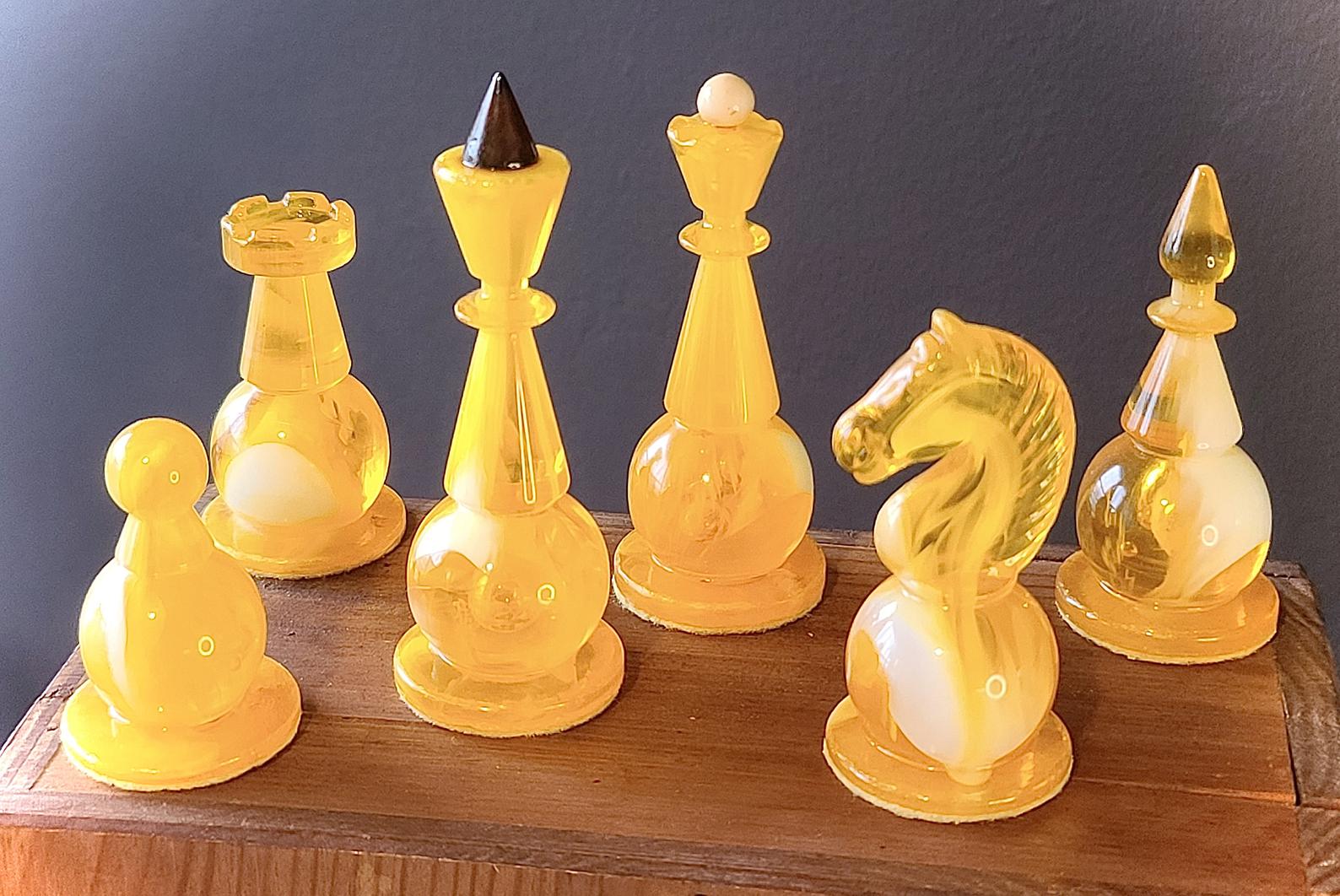
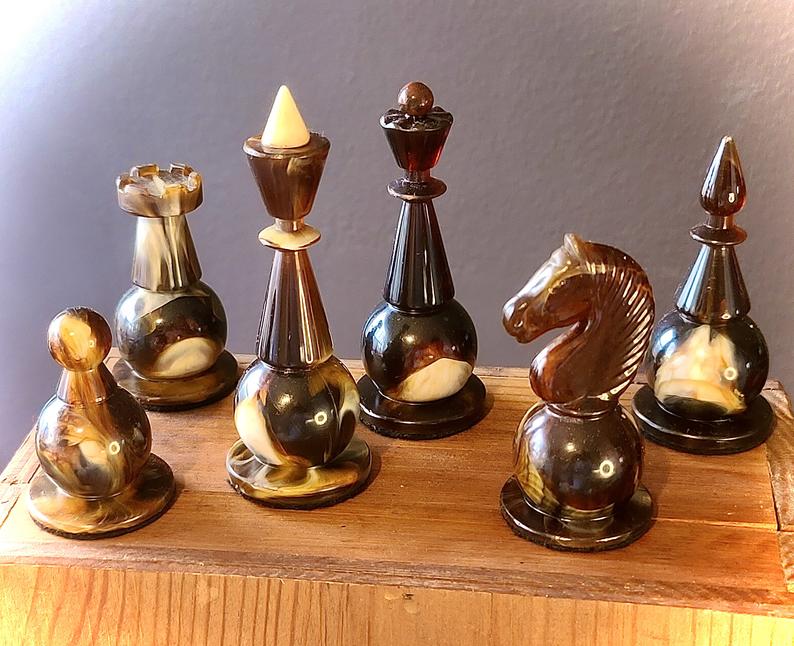

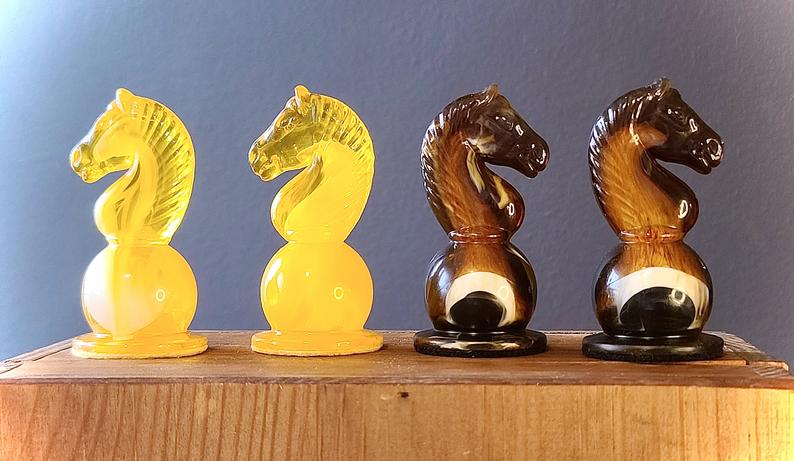

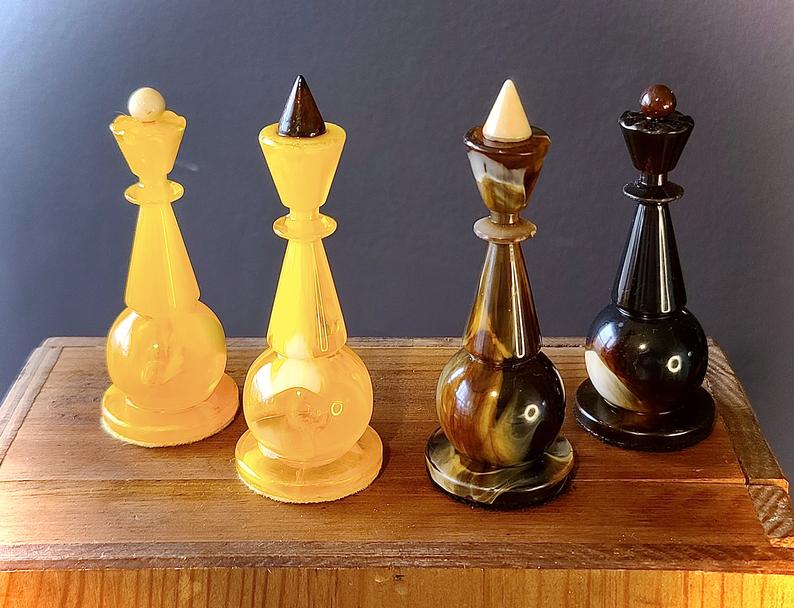
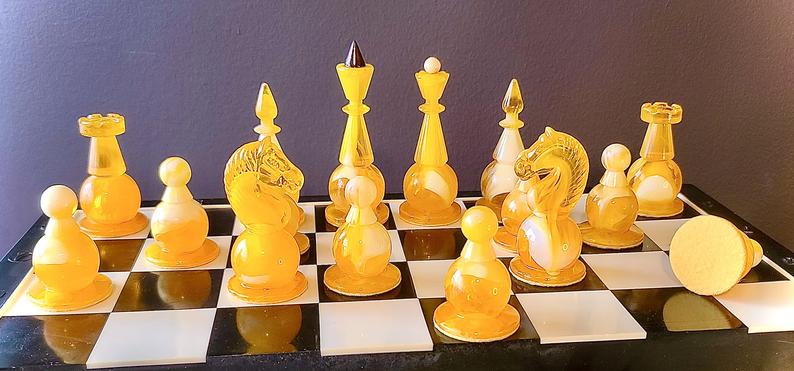
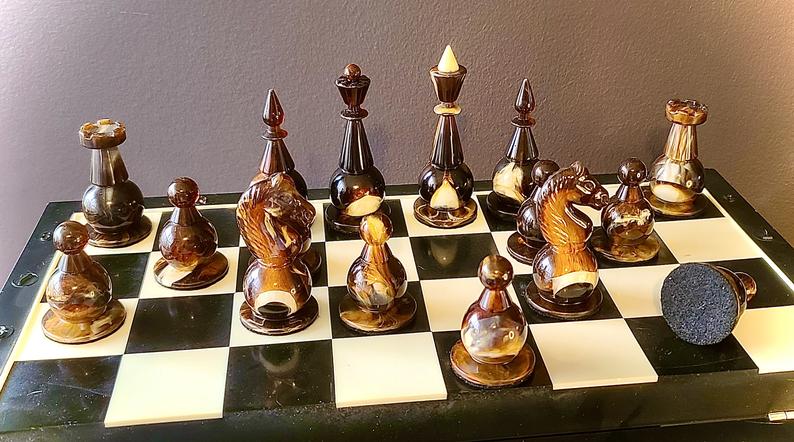
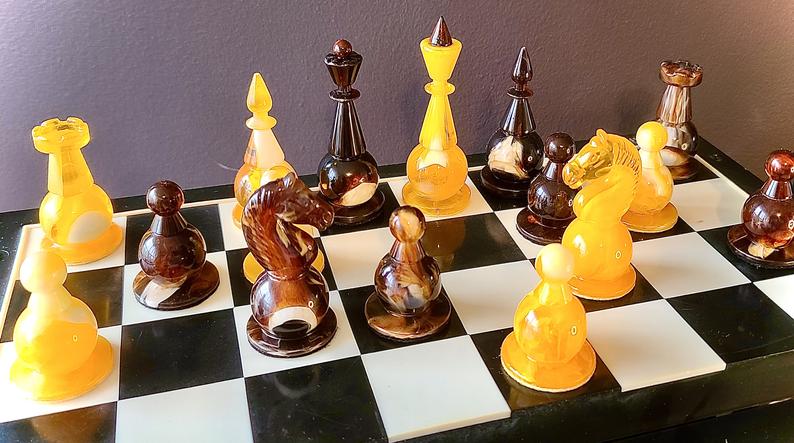
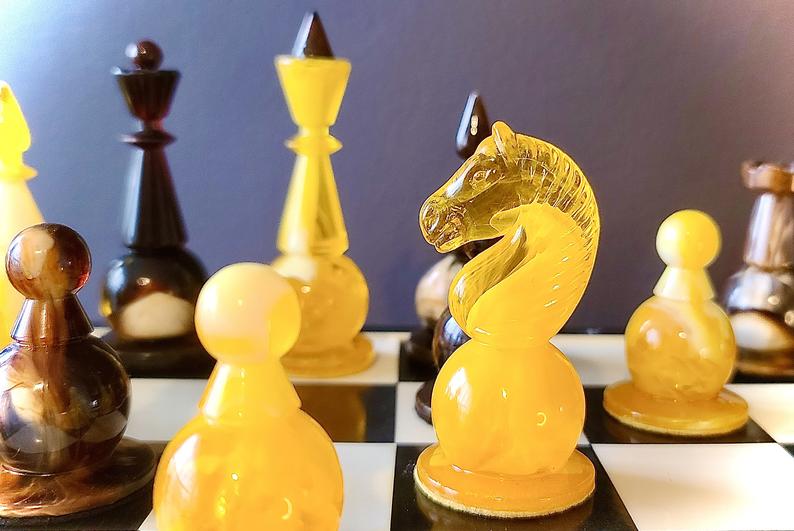
*SOLD!* Solis Electrum (Amber Sun); Ambroid Moscow 1980 Summer Olympics Presentation Chess Set, c.1975-1985
Solis Electrum (Amber Sun): 32 weighted ambroid chessmen without board, resin, amber v. deep brown, artistically restored, c.1980
Height: King 10cm, wt 32g, base width (all pieces) 3.5cm, Queen 9cm 30g, Bishop 8cm 28g, Knight 7cm 28g, Rook 6cm 28g, Pawn 5cm 20g
W: plush yellow felt pads, B: black felt pads
I refer the interested reader of these lines to my October 2020 ‘Chessay’ on our ALL ABOUT CHESS page for a more detailed account of these historic and quite unique ambroid chess pieces, a brief outline of which I’ll give here.
“Cutting to the quick, ambroid or amberite, the material these explosively colourful pieces are derived from, can simply be defined as ‘faux amber’ consisting in the main part of minute fragments and crumbs of actual “famous Baltic amber,” sometimes referred to as ‘Russian Gold’ that is finely ground and then heavily compressed into moulded forms using heat. When this raw amber dust is heated above 200°C (392°F) it decomposes, yielding what is called ‘oil of amber’ or ‘pitch.’ When this is dissolved in linseed or turpentine oil it forms ‘amber varnish’ or ‘lac.’ Today, as in the past, many types of modern ‘plastic resin’ products use the same basic methods for their sealers and lacquers, which along with shellac (an insect based product) are mainly responsible for the glistening, honey-glazed varnishes found on many of the vintage chess pieces we so cherish today. That being said, we now have a fairly good idea of what we are handling when owning one of these vintage and visually stunning 1980 Moscow Olympic sets.”
The sets originate from the city of Kaliningrad, or more specifically the old ‘gulag’ called ‘The Kaliningrad Amber Combine,’ which still operates today, but not, thankfully, as an enforced labour camp! For a more detailed history of Kaliningrad and the ‘Konigsberg Amber Factory’ (as it was known before being renamed by Stalin in 1947), I refer the reader to the October Chessay glossed over above. Just click here for more info.
You may well find these sets from time to time over the internet or via some of the well-known Soviet auction houses, but I can assure you, none will be as pleasing on the eye as to what you find here in our galleries. I source and restore the best quality sets I can find on the market and most sellers come directly to me with their finds, for which I am greatly thankful.
The pieces are UV resistant and ideal for display as well as casual and blitz play. Both kings carry the iridescent silver 2020 hand-painted ‘power’ signature of the artist on their bases – and, if you look very carefully – INSIDE!!! – the translucent ambroid base too! A first for The Chess Schach!
Ref code: SE20
Excerpts from the Chess Schach’s Chessay, ‘AMBROID ALERT’ cannot be reprinted without permission. All rights reserved: Alan W. Power, 2020
Visit our Gallery for more artistically restored vintage chess sets.
Feeling social? Follow us on Instagram, Facebook, or Twitter!